
ACADEMIC TALK
Watch the lecture by Dr Greenstreet below and don’t forget to take a look at the extra resources and have a go at the activity at the end.
Realisms from Victorian novels to contemporary fiction
Dr Hannah Greenstreet
A lot of people might think that one function of storytelling is to represent reality. But what does reality actually mean? How have our conceptions of reality developed over time? Exploring different novels from the Victorian period to the present day can help us understand the variety of different things that we associate with realism.
How have novelists attempted to represent real life in their books? In this academic talk, Dr Hannah Greenstreet introduces us to different ideas of realism and how artistic representations of the real have changed over time along with our understanding of reality. She also offers some approaches to analysing passages from novels, which are essential skills for those studying literature or languages at A-Level or considering degrees in these subjects.
You can also find links to the extracts on the slideshow underneath the video.
Adam Bede (1859) by George Eliot
Chapter 17 ‘In Which the Story Pauses a Little’
Extract 1, Realism vs Idealism:
‘“THIS Rector of Broxton is little better than a pagan!” I hear one of my readers exclaim. “How much more edifying it would have been if you had made him give Arthur some truly spiritual advice! You might have put into his mouth the most beautiful things—quite as good as reading a sermon.”
Certainly I could, if I held it the highest vocation of the novelist to represent things as they never have been and never will be. Then, of course, I might refashion life and character entirely after my own liking; I might select the most unexceptionable type of clergyman and put my own admirable opinions into his mouth on all occasions. But it happens, on the contrary, that my strongest effort is to avoid any such arbitrary picture, and to give a faithful account of men and things as they have mirrored themselves in my mind. The mirror is doubtless defective, the outlines will sometimes be disturbed, the reflection faint or confused; but I feel as much bound to tell you as precisely as I can what that reflection is, as if I were in the witness-box, narrating my experience on oath.
[…] So I am content to tell my simple story, without trying to make things seem better than they were; dreading nothing, indeed, but falsity, which, in spite of one’s best efforts, there is reason to dread. Falsehood is so easy, truth so difficult. The pencil is conscious of a delightful facility in drawing a griffin—the longer the claws, and the larger the wings, the better; but that marvellous facility which we mistook for genius is apt to forsake us when we want to draw a real unexaggerated lion. Examine your words well, and you will find that even when you have no motive to be false, it is a very hard thing to say the exact truth, even about your own immediate feelings—much harder than to say something fine about them which is NOT the exact truth.’
Extract 2, Dutch paintings:
‘It is for this rare, precious quality of truthfulness that I delight in many Dutch paintings, which lofty-minded people despise. I find a source of delicious sympathy in these faithful pictures of a monotonous homely existence, which has been the fate of so many more among my fellow-mortals than a life of pomp or of absolute indigence, of tragic suffering or of world-stirring actions. I turn, without shrinking, from cloud-borne angels, from prophets, sibyls, and heroic warriors, to an old woman bending over her flower-pot, or eating her solitary dinner, while the noonday light, softened perhaps by a screen of leaves, falls on her mob-cap, and just touches the rim of her spinning-wheel, and her stone jug, and all those cheap common things which are the precious necessaries of life to her […] “Foh!” says my idealistic friend, “what vulgar details! What good is there in taking all these pains to give an exact likeness of old women and clowns? What a low phase of life! What clumsy, ugly people!”
But bless us, things may be lovable that are not altogether handsome, I hope? […] There are few prophets in the world; few sublimely beautiful women; few heroes. I can’t afford to give all my love and reverence to such rarities: I want a great deal of those feelings for my every-day fellow-men, especially for the few in the foreground of the great multitude, whose faces I know, whose hands I touch, for whom I have to make way with kindly courtesy.’
Follow this link to read more.
Middlemarch (1871-72) by George Eliot
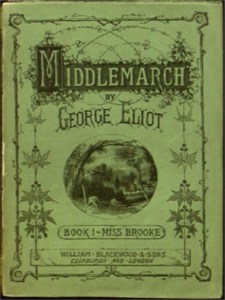
Extract from the Finale:
‘Certainly those determining acts of her life were not ideally beautiful. They were the mixed result of young and noble impulse struggling amidst the conditions of an imperfect social state, in which great feelings will often take the aspect of error, and great faith the aspect of illusion. For there is no creature whose inward being is so strong that it is not greatly determined by what lies outside it. A new Theresa will hardly have the opportunity of reforming a conventual life, any more than a new Antigone will spend her heroic piety in daring all for the sake of a brother’s burial: the medium in which their ardent deeds took shape is forever gone. But we insignificant people with our daily words and acts are preparing the lives of many Dorotheas, some of which may present a far sadder sacrifice than that of the Dorothea whose story we know.
Her finely touched spirit had still its fine issues, though they were not widely visible. Her full nature, like that river of which Cyrus broke the strength, spent itself in channels which had no great name on the earth. But the effect of her being on those around her was incalculably diffusive: for the growing good of the world is partly dependent on unhistoric acts; and that things are not so ill with you and me as they might have been, is half owing to the number who lived faithfully a hidden life, and rest in unvisited tombs.’
Follow this link to read more.
Mrs Dalloway (1925) by Virginia Woolf
Opening:
‘Mrs. Dalloway said she would buy the flowers herself.
For Lucy had her work cut out for her. The doors would be taken off their hinges; Rumpelmayer’s men were coming. And then, thought Clarissa Dalloway, what a morning–fresh as if issued to children on a beach.
What a lark! What a plunge! For so it had always seemed to her, when, with a little squeak of the hinges, which she could hear now, she had burst open the French windows and plunged at Bourton into the open air. How fresh, how calm, stiller than this of course, the air was in the early morning; like the flap of a wave; the kiss of a wave; chill and sharp and yet (for a girl of eighteen as she then was) solemn, feeling as she did, standing there at the open window, that something awful was about to happen; looking at the flowers, at the trees with the smoke winding off them and the rooks rising, falling; standing and looking until Peter Walsh said, “Musing among the vegetables?”–was that it?–“I prefer men to cauliflowers”–was that it? He must have said it at breakfast one morning when she had gone out on to the terrace–Peter Walsh. He would be back from India one of these days, June or July, she forgot which, for his letters were awfully dull; it was his sayings one remembered; his eyes, his pocket-knife, his smile, his grumpiness and, when millions of things had utterly vanished–how strange it was!–a few sayings like this about cabbages.
She stiffened a little on the kerb, waiting for Durtnall’s van to pass. […] In people’s eyes, in the swing, tramp, and trudge; in the bellow and the uproar; the carriages, motor cars, omnibuses, vans, sandwich men shuffling and swinging; brass bands; barrel organs; in the triumph and the jingle and the strange high singing of some aeroplane overhead was what she loved; life; London; this moment of June.’
Follow this link to read more.

Normal People (2018) by Sally Rooney
Read the extract from Normal People here (pages 1-2).

What do you think?
What have you read recently? Do you think it could be considered an example of realism?
Now you’ve watched the talk, how would you define realism?
Further resources
Realism – The British Library (bl.uk)
Realism and English Literature
Resource written by Dr Hannah Greenstreet for the St John’s Inspire Programme Summer School.
Realism is often associated with journalism, as an attempt to give an accurate account of real life. While George Orwell is known for his dystopian fiction, such as 1984 or Animal Farm, he was also an influential journalist who particularly focused on reporting on the conditions of working-class life. His semi-autobiographical Down and Out in Paris and London, which you can look at here, is an important work of social realism.
If you are interested in finding out more about Virginia Woolf’s approach to the novel, her essay ‘Mr Bennett and Mrs Brown’, which you can find here, provides useful insight into the importance of character to her work.
If you would like to think more about the definition of realism, you could read this academic article by David Shumway.

As you have just seen, George Eliot is interested in highlighting the lives of people who often go unacknowledged, those who ‘rest in invisible tombs’.
Think about a book that you have read recently. Is this book an example of realism? What characters does it have that would not be considered main characters, or central to the plot, but rather can be thought of as those who ‘rest in invisible tombs’?
Write a short analysis of one of these characters – how they are presented, what role they play, etc – and use this to make an argument whether or not this book is a work of realism, remembering to keep in mind the different definitions of realism that you have heard throughout this lecture.
